Moving from magnetic stripe cards to modern token technology
Upgrading your legacy systems to Radio Frequency Identification (RFID) or Near Field Communication (NFC) tokens gives your team a more reliable way to manage access and payments. You can implement these modern standards gradually without forcing a hard cutoff that might disrupt your daily operational flow. A carefully paced transition means your users continue to navigate the facility smoothly while you install and test the new readers. Taking this measured approach provides reassurance that you can modernize your infrastructure without risking unexpected downtime or frustrating your user base.
Evaluating your existing infrastructure for compatibility
Before introducing new hardware, you must assess how your current magnetic stripe readers are physically mounted and powered. Legacy units often sit in deep slots, rely on heavy countertop integration, or use direct terminal screws that make removal complicated. Modern RFID readers require flat surface placement, adhesive backing, or simple wall mounting brackets that do not fit into those older physical footprints. You will also find that legacy connections like old serial ports cannot supply the continuous electrical power required to run modern internal radio frequency modules. Documenting these physical constraints helps your team plan exactly where the new devices will sit and how they will draw power.
Your team must also evaluate the software backend to understand how data formats will change during the upgrade. Magnetic stripe readers use induction coils to read static data structured in strict numeric tracks, which established protocols like ISO/IEC 7811 then process. Modern tokens often output alphanumeric characters or longer data strings that can cause older point-of-sale software to crash or reject the input entirely. Upgrading requires checking that your existing software frameworks can handle the cryptographic handshakes and faster data exchange rates demanded by contactless devices. Identifying these software parsing limitations early allows you to update your backend systems before the first new token is ever scanned.
Structuring a staged migration process
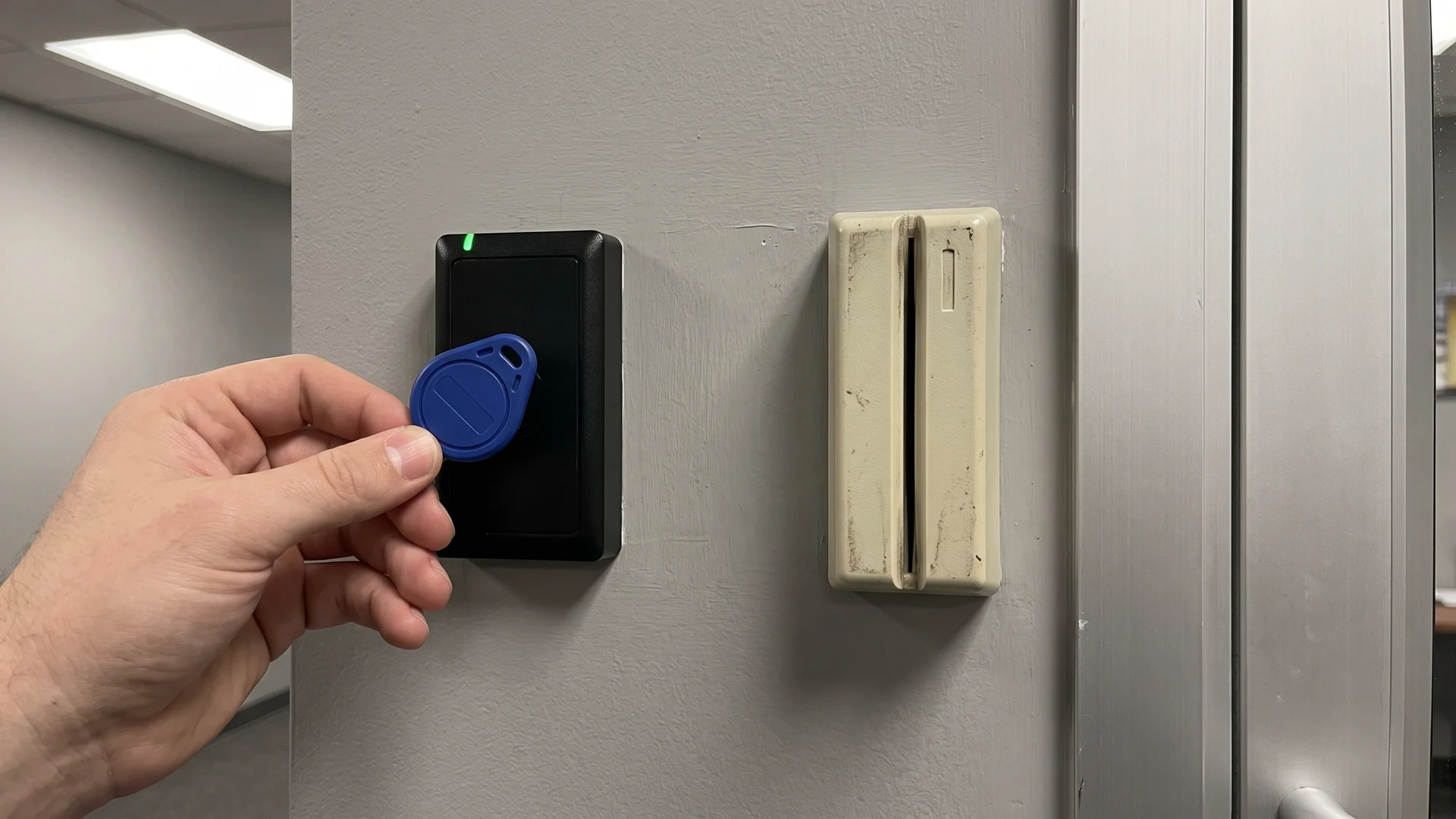
Running both legacy magnetic stripe readers and new token readers simultaneously forms the safest path for a smooth transition. This dual system approach ensures that your operations never stop while you deploy the new hardware across your facility. You can build a realistic rollout schedule that allows your staff to test the new workflow in isolated areas before expanding it. Following a clear sequence gives your project managers the confidence to oversee the implementation without fearing a sudden system failure.
- Hardware overlap: You begin by installing the new RFID or NFC readers alongside your existing magnetic stripe terminals at all primary access points. This physical overlap guarantees that users can still swipe their old legacy cards if they have not yet received their new tokens. Keeping both systems powered and active prevents bottlenecks during peak hours while your team monitors the initial performance of the new hardware. Providing two functional options at every terminal builds trust with your user base right from the start.
- Database synchronization: Your backend software must link the legacy card data and the new token data to the same user profile simultaneously. This synchronization ensures that a user retains their specific permissions or account balances regardless of which technology they use on a given day. Maintaining this shared database logic is a critical step that prevents double billing or accidental access denials during the transition period. You must test this dual entry system thoroughly to confirm that actions taken on a token update the central system instantly.
- Gradual distribution: You issue the new tokens to your users in distinct phases rather than attempting a massive single day rollout. Starting with a small department or a specific group of customers allows you to gather feedback and resolve minor technical friction early. As confidence in the new system grows, you can steadily increase the distribution volume until every user has made the switch. This phased strategy keeps your support staff from being overwhelmed by questions or replacement requests all at once.
Selecting the right technology for your environment
Choosing the correct standard requires understanding the functional differences between various radio frequencies and how they behave in your physical space. The right choice depends heavily on your required read range, the amount of data you need to store, and the environmental factors surrounding your equipment. You do not need to be a wireless engineer to make this decision, but grasping the basic capabilities of each technology protects your investment. Evaluating these factors objectively helps you deploy a solution that genuinely supports your daily operational workflow.
Understanding radio frequency identification ranges
RFID systems operate across different frequency bands that dictate how far away a token can be read and how quickly data transfers. Low Frequency (LF) systems operate between 125 and 134 kilohertz, offering a short range under 10 centimeters but providing excellent resistance to interference from water and heavy metals. High Frequency (HF) systems operate at 13.56 megahertz, giving you faster data rates and a moderate range up to one meter. Ultra-High Frequency (UHF) systems operate between 860 and 960 megahertz, delivering ranges of several meters for fast tracking, though they can struggle near liquids or metals without specialized tags. You must match these specific frequency traits to your facility layout to ensure reliable daily performance.
Reviewing near field communication limits
NFC is a specialized subset of high frequency technology that limits data transmission distance intentionally to enhance security. Instead of radiating radio waves over long distances, NFC relies on magnetic field coupling, meaning the reader and the token behave like a shared electrical air-core transformer. This physical design restricts the reliable operational range to under four centimeters, which forces the user to make a deliberate tapping motion. Because the energy transfers only across this tiny gap, the standard inherently prevents accidental reads and makes eavesdropping incredibly difficult. Understanding this limitation helps you position NFC readers where users can easily reach them without awkward stretching or guessing.
Matching the technology to your workflow
Once you understand the range limitations, you must consider what physical environmental factors might interfere with signal accuracy in your building. Dense obstacles like concrete walls, metal surfaces, and heavy machinery create electromagnetic interference that can distort radio waves and cause frustrating misreads. You also need to look at data storage capacity, which varies from simple 64-bit identifiers for basic access to larger memory banks capable of storing detailed user histories. If your environment is highly industrial and requires hands-free tracking, a UHF system provides the long range visibility your team needs. If your priority is secure point-of-sale transactions or tightly controlled door access, an NFC deployment offers the exact precision and security required.
Communicating system changes to your user base
Upgrading your hardware is only half the project, because you also need to guide your staff and customers through a change in their daily habits. Your communication strategy should focus on the practical benefits the new tokens bring, such as faster entry times and fewer frustrating misreads at the scanner. You must inform them well in advance about when the transition begins and exactly where they can collect their new credentials. Providing clear instructions on how to hold or tap the new tokens reduces the anxiety that often accompanies a shift in technology. When users understand why the change is happening, they are far more likely to adopt the new system quickly and enthusiastically.
As the rollout date approaches, your team should place visible, easy-to-read signage directly next to the new readers. These physical reminders help users adapt their muscle memory in the moment, rather than relying on an email they read weeks ago. You should also establish a dedicated support channel where people can ask questions or report issues without feeling embarrassed about their confusion. Addressing the human element of technology deployment ensures that your migration is successful both operationally and organizationally. Thoughtful communication turns a potentially disruptive technology change into a positive experience that builds trust across your facility.
Finalising the switch and retiring legacy hardware
Once your new system is fully adopted and every user has transitioned successfully, you can finally decommission your legacy magnetic stripe readers. Your technical team must safely uninstall the old hardware and remove any outdated serial connections or power supplies that clutter your infrastructure. You must also update your backend software one last time to purge the legacy processing protocols, ensuring that your system runs exclusively on the new standards. Cleaning up these outdated components gives your project a clear endpoint and leaves you with a modern, streamlined environment. If your team has general inquiries about technical standards as you maintain your updated infrastructure, consulting a neutral educational resource like RFID & NFC at contact@rfidandnfc.com can help guide your ongoing operations.
Can we run magnetic stripe and RFID or NFC side by side during the transition?
Yes. Run both by installing dual interface readers or attaching an external Near Field Communication (NFC) pad to your existing terminal. Keep magnetic stripe active as a fallback while you enroll Radio Frequency Identification (RFID) tokens, map identifiers in your backend, and set a staged cutover window.
How do we assess if our terminals can be retrofitted?
Retrofit when you can add an external NFC or RFID reader without breaking power, space, or enclosure limits. Replace when the terminal lacks power for a radio field, cannot support Europay, Mastercard, and Visa (EMV) contactless, or has sealed slots that block mounting. Start with a quick onsite audit.
What software and backend checks prevent surprises?
Run these checks before rollout. Validate data field sizes and character sets, then confirm software can parse sentinels without crashing. Verify the communication path, including keyboard wedge mode versus drivers, and confirm International Organization for Standardization (ISO) 8583 mapping if you process payments. Test bidirectional handshakes in a lab.
Which RFID frequency range fits our use case?
Match frequency to your range and environment. Low Frequency (LF) reads within a few centimeters and tolerates metal and water. High Frequency (HF) includes NFC, reads up to one meter, and suits cards and phones. Ultra High Frequency (UHF) spans several meters for assets, but struggles near liquids and metal.
How should we communicate the change to users and reduce confusion?
Communicate early and make it simple. Publish a clear timeline, label readers, and run a dual acceptance period so users can swipe or tap. Provide quick scripts for front line staff, collect feedback daily, and keep a visible fallback path for anyone who cannot switch on day one.